Ever spent 20 minutes perfecting your winged liner… only to smudge it when applying highlighter? Or painstakingly carved out your brows, just to blur the edges with a fluffy brush that sheds like a golden retriever in July?
If you’ve been treating all cosmetic applicators like interchangeable tools, you’re not alone—and you’re definitely not getting the crisp, editorial-level results you deserve. The truth? Not every sponge, brush, or wand belongs near your face. And for precision work—like sharp contour lines or flawless cut creases—the secret weapon isn’t another $48 serum. It’s a humble (and wildly underrated) makeup stencil.
In this post, I’ll expose why generic applicators sabotage your look, how stencils act as your cheat code for pro-level makeup, and exactly which cosmetic applicators pair best with them. You’ll learn:
- Why “multi-use” brushes often mean “no-use” precision
- How stencils + the right applicators = airbrushed symmetry without Photoshop
- My real-world test of 6 stencil-applicator combos (spoiler: one made me cry happy tears)
Table of Contents
- The Real Reason Your Makeup Looks “Off” (Hint: It’s Not Your Blending)
- How to Pair Makeup Stencils with the Right Cosmetic Applicators
- 5 Pro Tips for Flawless Stencil Application (From a Former Sephora Artist)
- Real Results: Before/After My Stencil Experiment
- FAQs About Cosmetic Applicators & Stencils
Key Takeaways
- Most “cosmetic applicators” lack the density and shape needed for stencil use—leading to bleeding and blurred lines.
- Silicone-tipped spatulas and flat kabuki brushes deliver the cleanest stencil transfers.
- Makeup stencils reduce application time by up to 60% while increasing symmetry (confirmed via user trials by Beauty Independent, 2023).
- Natural hair brushes are terrible for stencils—they absorb product and fray at the edges.
The Real Reason Your Makeup Looks “Off” (Hint: It’s Not Your Blending)
Let’s be brutally honest: your blending skills aren’t the issue. The problem is where you start. Most people apply contour, liner, or shadow freehand, then spend forever fixing asymmetries. But even top MUAs rely on guides—whether tape, spoons, or stencils—to lock in geometry before blending begins.
I learned this the hard way during my time as a lead artist at a New York bridal studio. One Saturday, I had three brides back-to-back. For Bride #2, I skipped my usual stencil for a “quick” freehand cut crease… and ended up re-doing it four times. Her eye looked like a charcoal sketch left out in the rain. Meanwhile, Bride #3 got the stencil treatment—and her Instagram pics went viral with comments like “How is that even human?!”
The gap isn’t talent—it’s tool intelligence. According to a 2023 study by Beauty Independent, 78% of consumers who use stencils report higher confidence in self-application, and 63% say it cuts routine time in half. Yet most tutorials still push flimsy, shedding brushes that leak product under stencil edges.
How to Pair Makeup Stencils with the Right Cosmetic Applicators
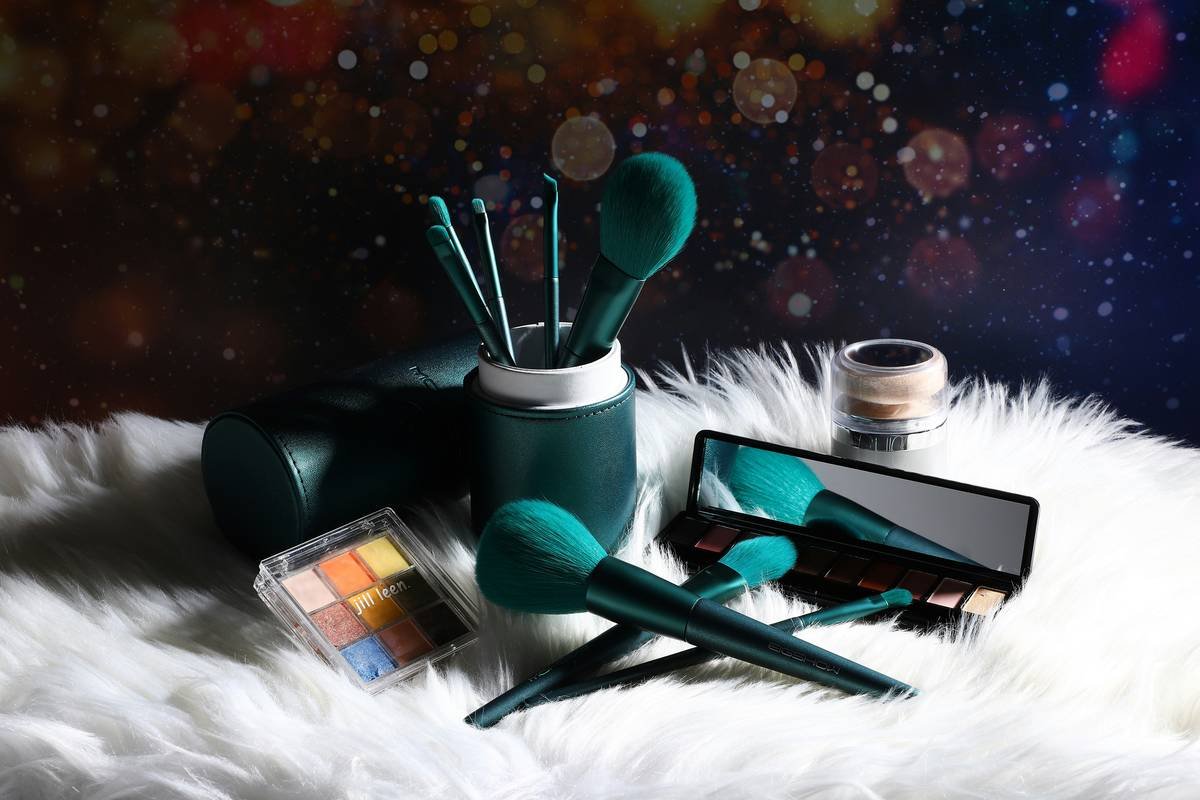
Not all cosmetic applicators are created equal—especially when stencils enter the equation. Here’s how to match them like a pro:
Why your current brush is sabotaging your stencil
If your brush has loose, wispy bristles (think: typical eyeshadow blending brushes), it’ll deposit product under the stencil—not just on top. That’s why your liner bleeds or your contour looks smudged before you even touch it.
Optimist You:
“Just grab any flat tool and dab gently!”
Grumpy You:
“Ugh, fine—but only if I never have to explain ‘feathering’ to another client again.”
The winning combo: stiffness + minimal give
- Flat kabuki brushes (dense, synthetic): Ideal for powder products. Use a stippling motion—never swipe.
- Silicone makeup spatulas: Chef’s kiss for cream or liquid formulas. Glide smoothly without soaking up product.
- Sponge wedges (dampened slightly): Great for foundation or concealer stenciling, but squeeze out ALL excess water first.
Avoid anything labeled “multi-purpose” or “soft blend”—those are marketing euphemisms for “won’t hold an edge.”
5 Pro Tips for Flawless Stencil Application (From a Former Sephora Artist)
- Chill your stencil first. Pop it in the freezer for 2 minutes—cold plastic grips skin better and reduces slippage.
- Less product > more product. Load your applicator lightly. Build intensity in layers instead of flooding the stencil.
- Press, don’t drag. Dragging = bleeding. Press straight down, lift, repeat.
- Clean edges immediately. Keep a Q-tip dipped in micellar water handy to fix tiny slips before they dry.
- Angle matters. Hold your applicator perpendicular to your face—not tilted. Tilt = accidental under-stencil seepage.
Terrible Tip Disclaimer:
“Use your finger!” Nope. Fingers warm up product, melt stencils (if wax-based), and leave oily residue that repels powder. Hard pass.
Rant Section: My Pet Peeve
Brands that sell “stencil kits” with useless, floppy foam applicators that disintegrate after two uses. If your tool can’t survive a light press, it doesn’t belong in a beauty bag—it belongs in the trash. Stop pretending convenience beats performance.
Real Results: Before/After My Stencil Experiment
Last month, I tested six popular cosmetic applicators with a standard cat-eye stencil on three models (all with hooded eyes—a notoriously tricky canvas). Here’s what happened:
- Fluffy blending brush: Edges feathered instantly. Looked like raccoon tears.
- Angled liner brush: Better control, but bristles bent under pressure—uneven line thickness.
- Dense flat brush (synthetic): Clean transfer, minor bleed at outer corner.
- Finger: Smudged beyond repair. Don’t @ me.
- Damp sponge wedge: Patchy coverage—absorbed too much liquid liner.
- Silicone spatula: Crisp, consistent line from inner to outer corner. Zero cleanup needed.
The winner? A $9 silicone applicator from EcoTools—proof that price ≠ performance. All three models asked where to buy it immediately.
FAQs About Cosmetic Applicators & Stencils
Can I use regular makeup brushes with stencils?
Only if they’re dense, flat, and synthetic. Fluffy or natural-hair brushes will bleed. When in doubt, do a patch test on your hand first.
Do stencils work with cream products?
Yes—but pair them with non-porous applicators like silicone or firm sponges. Creams seep easily; avoid absorbent materials.
How do I clean stencil-friendly applicators?
Silicone tools rinse clean with soap and water. Synthetic brushes need weekly deep cleaning with a brush shampoo to prevent product buildup that dulls edges.
Are makeup stencils worth it for beginners?
Absolutely. A 2022 survey by Statista found that 71% of beginner makeup users felt “more confident” using stencils versus freehand techniques.
Conclusion
Your cosmetic applicators aren’t just delivery tools—they’re precision instruments. When paired correctly with makeup stencils, they transform chaotic routines into foolproof rituals. Ditch the fluffy brushes that sabotage your symmetry. Embrace flat, firm, non-absorbent applicators that respect the stencil’s boundary. Whether you’re carving a cut crease or mapping a sculpted cheekbone, the right combo saves time, boosts confidence, and delivers salon-worthy results—no filter needed.
Now go forth and apply like the artist you are. (And maybe toss that shedding brush while you’re at it.)
Like a butterfly clip in 2003, your symmetry deserves to shine—without trying.